

Small but disruptive leaks
The existing gutter at Luxe Rendezvous had been assembled from separate sections of thin aluminium sheet. The aluminium itself remained intact, but water was finding its way through the interfaces between the sections.
Repeated heavy flow progressively opened these gaps, allowing increasing amounts of water to enter the female staff dormitory below.
By mid-June, the rains were already well under way and the continuing water ingress was creating unacceptable sleeping conditions. Waiting for the rainy season to pass was not an option: the failed section had to be measured, fabricated and replaced as quickly as possible.
One continuous six-metre gutter
The replacement was approached from the outset as one continuous six-metre gutter.
Three standard-sized polypropylene panels were cut into the required base and side sections, then thermally welded into a continuous U-shaped profile.
The 35 mm thickness gave the completed gutter sufficient rigidity for handling and positioning without additional internal or external reinforcement. Once installed, it rested on the existing wooden brackets at intervals of approximately 1.5 metres.
The remainder of the drainage system (close to 30 meter in total) did not require replacement. AquaTelos was asked to replace only the failed six-metre section and connect the new gutter to the existing rainwater-discharge system.

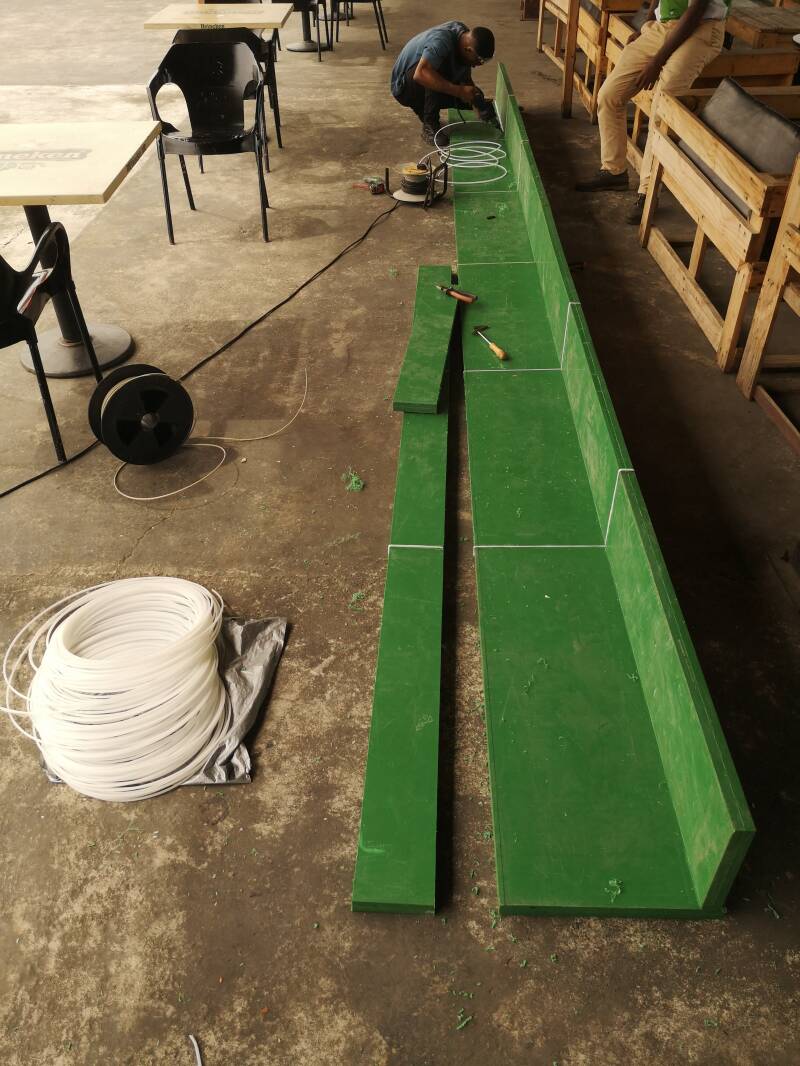

Choosing to fabricate on site
The gutter could technically have been prefabricated at our workshop, but the exact available space could only be measured after the leaking section had been removed.
Working on site allowed AquaTelos to optimise the dimensions and position of the U-shaped channel within the exposed roof structure. The carpenter positioned the wooden brackets to establish the required slope towards the outlet, after which the gutter could be aligned with those supports before final welding.
Luxe Rendezvous is located on top of Apapa Mall, practically neighbouring our workshop, so retaining this flexibility carried little logistical penalty.
Why polypropylene
Polypropylene does not rust, rot or absorb water, making it well suited to continuous exposure to rain and humidity.
Thermal welding produces continuous joints rather than interfaces that depend on mechanical fasteners or sealants to remain watertight. The material can also be cut and fabricated around existing structures where standard gutter profiles do not fit.
For this project, recycled polypropylene provided the required water resistance and rigidity while giving recovered material a durable new application.
From open channel to round drain
Once the six-metre gutter had been completed, it was slid directly onto the prepared wooden supports and connected to the existing drainage route.
At the discharge point, AquaTelos added a square transition piece between the polypropylene gutter and the round PVC downpipe.
The wider interface captures the water leaving the open channel before directing it into the circular pipe. This prevents water from splashing over at the transition and towards the dormitory below.

